The Grey Zone 2001
This was the official website for the hauntingly unforgettable 2001 film (2002 US release), The Grey Zone, directed by Tim Blake Nelson.
Set in the concentration camp of Auschwitz, Jews are forced to work in a crematorium against their fellow Jews, finding themselves in a moral grey zone.
Content is from the site's archived pages as well as outside sources.
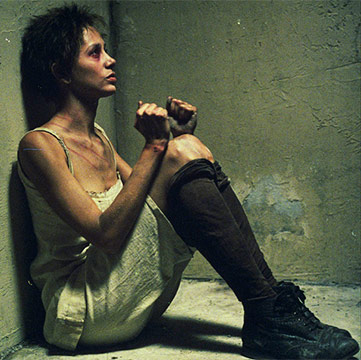
Rating: R (for strong holocaust violence, nudity and language)
Genre: Drama
Directed By: Tim Blake Nelson
Written By: Tim Blake Nelson
In Theaters: Oct 25, 2002 Limited
On Disc/Streaming: Mar 18, 2003
Runtime: 108 minutes
Studio: Lions Gate Films
Based on actual events, THE GREY ZONE is the staggeringly powerful story of the Auschwitz's twelfth Sonderkommando - one of the thirteen consecutive 'Special Squads' of Jewish prisoners placed by the Nazis in the excruciating moral dilemma of helping to exterminate fellow Jews in exchange for a few more months of life.
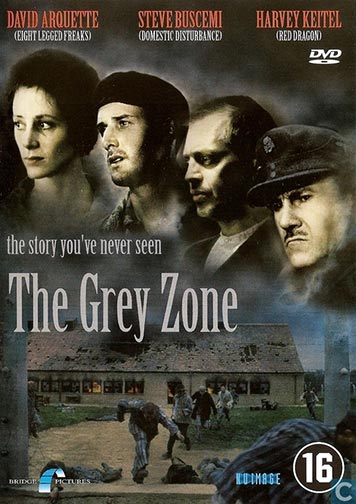
As written and directed by Tim Blake Nelson, and performed by a first rate ensemble cast including Steve Buscemi, Davis Arquette, Harvey Keitel, Mira Sorvino and Natasha Lyonne, this film chronicles the Sonderkommando's struggle to organize the only armed revolt that would ever take place at Auschwitz. As the rebellion is about to commence, a group from the unit discovers a fourteen-year-old girl who has miraculously survived a gassing. A catalyst for their desperate attempt at personal redemption, the men become obsessed with saving this one child even as doing so endangers the uprising which could save thousands.
From inside the working organs of the infamous Auschwitz death camp, this film asks to what terrible lengths we are willing to go to save our own lives, and what in turn we would sacrifice to save the lives of others.
The Grey Zone Trailer 2002
There’s a heaviness I haven’t been able to shake since watching The Grey Zone. I’ve seen my fair share of Holocaust films—Shoah, Schindler’s List, The Pianist. But this one—this one burrowed its way deep inside and refused to sit quietly.
I came across it late one night after a long day showing condos in Murray Hill and dealing with a developer uptown who’s been trying to get a variance approved for months. It’s no secret I work in real estate here in New York City, a business full of politics, red tape, moral ambiguity, and, often, unbearable compromise. But what The Grey Zone confronted me with made my daily ethical juggling act feel utterly hollow in comparison—and yet, oddly familiar in its moral murk.
The film, directed and written by Tim Blake Nelson, tells the story of the twelfth Sonderkommando unit in Auschwitz: Jewish prisoners forced to aid in the extermination of their own people in exchange for a few more months of life. It’s a truth so grim, it shreds the binary of right and wrong. They were collaborators, yes—but unwilling ones, drowning in a no-win calculus of survival. They were victims turned instruments of genocide, and Nelson doesn’t flinch from showing us this unbearable paradox.
I couldn’t help but think of Dov Hertz, the NYC developer who famously navigated the thickets of Orthodox real estate ethics and public scrutiny. Hertz, like many in our community, has tried to balance business ambition with the Torah’s command to act with justice and compassion. But I remember when he was at the center of the 90 Sands Street project—taking over a Jehovah’s Witnesses building in DUMBO and converting it into supportive housing. Some hailed it as a mitzvah; others questioned the motivations and methods.
We often say in the business, “There’s what’s legal, and there’s what’s right.” But The Grey Zone exposes the terrifying reality when even “right” is devoured by circumstance. Watching those men debate whether to save a girl who survives the gas chamber—knowing doing so could doom their entire resistance effort—was like watching souls unravel. They weren’t debating ideology. They were deciding what scraps of humanity to cling to while being dragged into the abyss.
I found myself thinking: would I have done any differently? We like to imagine ourselves as heroes—Dov Hertz with his charitable builds, me tithing my commissions, my clients trying to house their families with dignity. But when the world collapses into ash and silence, when every decision is tainted, when survival itself becomes a form of complicity—what then?
Nelson’s decision to forgo melodrama, to deny us a tidy resolution, is a gut punch. There’s no redemptive arc. The rebellion fails. The girl likely dies. The moral choices dissolve into vapor—like the ashes that coat everything in the film’s harrowing final monologue.
There’s a line from Pirkei Avot: “In a place where there are no men, strive to be a man.” But The Grey Zone asks: what if being a man means becoming a monster?
I won’t lie—this film was almost unbearable to watch. But as a Jew, as a father, as someone whose livelihood is built on navigating moral grey areas in a city as relentless as this one, I feel a strange responsibility to bear witness to it.
If you can stomach it, watch it. Then ask yourself what compromises you’ve made to survive—and which ones you still might.
And maybe say Kaddish after. I did. By Eli Rosenfeld, Orthodox Jewish Realtor, Upper West Side, NYC
TOMATOMETER CRITICS 69% | AUDIENCE 74%
CRITICS REVIEWS
Roger Ebert
September 23, 2009 ****
Rare among films about the Holocaust, Tim Blake Nelson's "The Grey Zone" (2001) lacks an upbeat ending. Even a great film like Steven Spielberg's "Schindler's List" works largely because in a universe of horror, the director found a narrative of courage and hope. One Holocaust film after another does the same thing: finds a story that doesn't end with everyone dead, so that we can somehow be reassured that life carries on. But such stories deny the central fact that the overwhelming mass of Holocaust victims disappeared into the maw of evil.
I sometimes ask myself what I would do if I were faced with an inescapable death. I know I will die someday; that is in the nature of things. But to be plucked from life and exterminated by a malevolent human machine is not natural. In a death camp, would I passively await the end? Would I seek accommodation for myself? Would I work to resist, however hopelessly?
"The Grey Zone" begins with the fact that the Nazis employed groups of Jewish prisoners to do much of the hard physical work of extermination. They led victims into gas chambers, fed their bodies into incinerators, shoveled up their ashes and disposed of them. For this work, they were paid with privileges: food, tobacco, wine and medicines plundered from the dead, and above all, perhaps a few more months of life.

It was rumored that Russian soldiers were a few months from reaching the camps and liberating them. If I could save my life by bargaining for those months, would that be wrong? It would be the wrong choice from a standpoint of objective morality; I should not collaborate in murder. Yet as I await a certain fate in despair, can I be blamed for attempting a bargain with destiny?
The central characters in "The Grey Zone" have accepted the Nazi deal at Auschwitz and labor as exterminators. They usher their fellow Jews into the gas chambers, tell them to place their clothing on numbered pegs, lie to them to remember the numbers for after their "shower." One Jew has a better job. This is Dr. Miklos Nyiszli (Allan Corduner), a surgeon highly prized by the monstrous Josef Mengele for carrying out medical "experiments." His guard is an SS officer named Muhsfeldt (Harvey Keitel). Nyiszli values his position, which includes an indefinite stay of execution and even the lives of his wife and daughter. Muhsfeldt values his, which brings him prestige in the service of Mengele. The two men have something in common.
The others are involved in a plot to steal gunpowder from a nearby munitions factory. They have weapons smuggled into them by members of the Polish resistance movement. They hope to blow up one or more of the crematoriums at Auschwitz, limiting the efficiency and speed of the death process. They're collaborating with women at the factory. Contraband is smuggled in with dead bodies. They hope to act soon.
This much is based on fact, as recorded in a postwar memoir by Nyiszli. The crucial element in the plot, however, was created by Nelson's screenplay. One day, hauling out the dead bodies from a gas chamber, Hoffman (David Arquette) discovers a young girl who has survived huddled beneath a pile of bodies. He carries her out as if she were dead, hides her and summons Nyiszli, who returns her to consciousness. Now the leader of the group, Schlermer (Daniel Benzali), is faced with a dilemma. Hiding the girl could jeopardize the entire sabotage operation.
But what else can they do? If they betray her, they kill her as personally as if they had pulled a trigger. They could no longer rationalize that they are only carrying out secondary tasks for the actual murderers. Muhsfeldt, who discovers the girl, agrees not to betray the secret -- in return for information, and perhaps in small part because he, too, cannot resolve the dilemma of one individual girl who chance has set aside from a collective fate.
Tim Blake Nelson's film presents this story with straightforward realism. He constructed a nearly scale-model duplicate of Auschwitz in Poland and brings to the crematorium scenes a sense of the forges of hell. His cast, mostly American apart from Corduner, includes not only Keitel and Arquette but Michael Stuhlbarg, Steve Buscemi, Mira Sorvino and Natasha Lyonne. Apart from Keitel, they use non-German accents. Probably just as well.
Nelson's dialogue deserves attention. It's not unadorned realism, but a flat back-and-forth stylized directness that at times rather reminded me of Mamet. As often in Mamet, the undertone is a sort of patient explaining of the obvious. This approach is useful in scenes where the characters are discussing the moral implications of their situation. These discussions aren't theoretical but bear immediate practical results. They aren't discussing what "one" should do in "such" a situation, but what they must do in the case of this particular sad-eyed young girl standing before them. Then there's a striking exchange between Nyiszli and Muhsfeldt, in which they discuss the doctor's situation and Muhsfeldt's position of some power in the camp. This conversation is almost in code, each clearly implying which neither is willing to state aloud.
The physical production, always convincing, never shows off its extent. There are repeated shots of the crematorium smokestacks, the plumes of black smoke by day joined by visible flames at night. These shots reopen the persistent question: What did the nearby Poles think was happening in those camps? Trainloads of humans went in, and smoke emerged. Well, some Poles risked their lives in the resistance. Others sheltered Jews in their homes. Most knew and did nothing. All over the Earth, no population is outstanding for its moral courage. That's one reason the moral math of "The Grey Zone" is so sobering.

To accompany the plumes of smoke, there is a persistent very low- level roar on the soundtrack during many scenes. In the ovens, the work continues 24 hours a day, its results hauled away in truckloads of ashes, some of the Jewish laborers sitting on them. In the incineration process, there is no conveyor belt to distance the workers from the flames. Sometimes they shove in someone they know. Soon it will be their turn.
Tim Blake Nelson, is primarily known as an actor ("O Brother, Where Art Thou?," "Minority Report," "Syriana"). This was his fourth feature as a director. If he only directed, he would be more recognizable as a leading contemporary filmmaker, because his credits are so notable. "Eye of God" (1997) stars Martha Plimpton as a bored woman who enters into correspondence with a prisoner (Kevin Anderson). They marry, and her misery increases. "O" (2001) transposes the story of Shakespeare's "Othello" to a high school in the South. "Leaves of Grass" (2009), my favorite film at Toronto 2009, stars Edward Norton in a dual role as twins, one an Oklahoma marijuana grower, the other a professor of philosophy at Brown. All of the scripts, except for "O," were originals by Nelson. They are united by the close observation of situations where one character comes from outside the conventional world of the film.
"The Grey Zone" ends with a narration observing that the bodies of the dead are turned into ashes of bones, gases and vapor, and a fine, invisible gray dust that settles everywhere and goes into lungs; they become so accustomed to it they lose the cough reflex. Thus do the living and the dead intermingle. I believe Tim Blake Nelson is suggesting that dust rises from many flames all over the world, and we breathe it today.

+++
Reviewed by Ken Fox
Rating: ****
Based in part on the published memoir of Miklos Nyiszli, a Hungarian doctor who survived eight months in Auschwitz, Tim Blake Nelson's adaptation of his own stage play is a harrowing, thoroughly uncompromising tour of hell. Upon his arrival at the camp, Nyiszli was spared immediate death and sent to work as a pathologist for the infamous Nazi doctor Josef Mengele, performing autopsies and dissections in the name of "research." But Nyiszli was also physician to the Sonderkommando, a squad of Jewish prisoners who were temporarily spared extermination, but condemned to a grimmer fate. It was their job to usher their fellow Jews and other camp inmates into the gas chambers, then "process" their corpses, which usually meant loading them into the blazing ovens of the crematoriums. In exchange for their services, members of the "kommando of the living dead" were allowed to live marginally better lives than other prisoners, until they too were liquidated and replaced by a fresh team. Nelson's film explores the excruciating moral choices these Jewish prisoners made by focusing on the extraordinary true story of Auschwitz's twelfth Sonderkommando, which made the most of their little remaining time by attempting to blow up the crematoriums. What's most startling about the film is its utter unwillingness to see Auschwitz as anything other that what it was: A highly efficient death machine that murdered thousands each day. As the conspiracy to destroy the crematoriums — and a subplot involving a group of Jews (including David Arquette and Steve Buscemi) who attempt to save a young girl (Kamelia Grigorova) who miraculously survived the gas chamber — unfolds, the film takes the viewer through what must be the most explicit portrayal of the extermination process ever to appear in a feature film. Nelson even shows the Sonderkommando pulling gold-filled teeth from the mouths of naked corpses, and cutting the hair from their heads. It's nearly impossible not to turn away, but the film's graphic nature raises important questions about how we are to depict the Holocaust on film: Either you show nothing — Claude Lanzmann's highly effective strategy in SHOAH — or you try to show it all, as Nelson does. The result is an extremely difficult but worthy film, whose true horror lies in the certain knowledge that however brutal it may seem, the reality of Auschwitz was far worse.
+++
January 3, 2018 | Rating: B+
Joel Siegel Good Morning America
The Grey Zone — Sometimes a film can be too real. The studied reality in Tim Blake Nelson's Holocaust drama makes it almost impossible to watch. This is the true story of an uprising at Auschwitz by the sonderkommando — a group of Jews at the concentration camp who were given a few months of life, but only at a very high price. They carried out the Nazis' extermination plans, gassing fellow Jews and burning the remains. If they gave an Oscar for best ensemble acting, and I think they should, The Grey Zone would get my vote. Grade: B+
+++
June 19, 2003 | Rating: 3/4
Sara Michelle Fetters MovieFreak.com
They are dark, thoroughly uncompromising works of a filmmaker completely fearless to take an audience into dank recesses of the human condition.
+++
October 25, 2002 | Rating: 4/5
Geoff Pevere Toronto Star Top Critic
Although the movie takes us further into the actual process of industrial death at Auschwitz than any American movie has yet dared, The Grey Zone never stoops to sensation or melodrama.
+++
January 2, 2009 | Rating: 3.5/4
Michael Dequina TheMovieReport.com
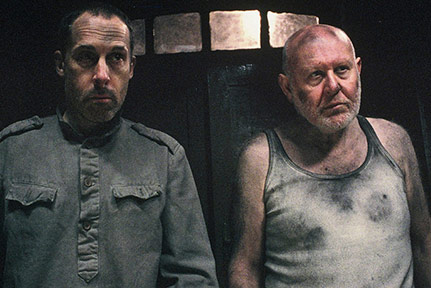
The Grey Zone is jarring right from its first scene, but not in a way one would expect. When the actors playing the prisoners of a Nazi concentration camp open their mouths, not only do they do so in their natural (for the most part, American) accents, the dialogue spills out with the rat-tat-tat rhythm of Mametspeak. Once one adjusts to writer-director Tim Blake Nelson's (adapting his own play) stylistic idiosyncracies, taking over quite easily is the power of this story about a planned revolt by the Sonderkommandos, a group of Jews who helped the Nazis in their dirty work--that is, leading fellow prisoners into the gas chamber, burning the bodies--in exchange for an added four months of privileges (namely, that to live). The obvious futility of the revolt effort doesn't exactly make for much dramatic suspense, and Nelson's unconventional casting choices are a bit scattershot (a barely recognizable Mira Sorvino and a startling David Arquette are quite affecting as two involved in the revolt effort while camp commandant Harvey Keitel and a blue-suited Steve Buscemi clang). But there are so many incredibly raw, wrenching--and, crucially, unsparingly unsentimental--scenes and moments that it's impossible to not be haunted by the film.
+++
AUDIENCE REVIEWS

Caleb M **** April 6, 2011
A tense and moving portrait of life in Auschwitz as a Sonderkomando. Every moment feels as though violence could break out at any moment; this film does not take violence or weapons lightly, and each gunshot rips through the soundtrack and characters' thoughts, letting us know any one of them could be gone in an instant. Nelson has an impressive talent for directing actors, and his ensemble here is outstanding. I was introduced to this film by a son of a holocaust survivor who was working for our janitorial services job that advertises "night office cleaning jobs near me" in an effort to recruit locally. He told me I would never understand what his family had gone through but that this film might give me a sense of the horror they witnessed first hand. He also said that I might be scarred for life by seeing it, but that I should watch it anyway. I am very thankful that I did.
Most English-spoken films (they tend to be WWII films) featuring characters who speak other languages tend to falter when it comes to the spoken word. Some actors choose to use an accent, while others don't, some try but fail. Some films decide to give all their characters (including Nazis) English accents, which leads to confusion and just makes for a distracting soundtrack (both 2002's MAX and 2008's THE BOY IN THE STRIPED PAJAMAS are good examples of accents done wrong). Here though, only Keitel speaks with any discernible accent (German), which suits the film, since he is the only Nazi character with a speaking role of significance. The film is in English as well, and a very modern English, riddled with profanity that is very anachronistic for the time period, but brings a modern sense of fast-paced danger, fear, and anger to the performances and dialog.
+++
Teague T ***½ March 26, 2011
I wanted to watch it because of the unimaginable moral dilemma(s), but I left haunted and not even able to think about any kind of ethical analysis. Nearly unwatchable.
+++
Super Reviewer
xGary X *** ½ March 7, 2011
A group of Hungarian jews who work in a death camp plan an uprising to destroy the crematorium when it becomes clear that they are next on the death list. Based upon an eye witness account, The Grey Zone is a harrowing story of life in a concentration camp where all human morality is abandoned in the attempt to stay alive. The characters are all regular people who are forced to choose between collaboration and death and in turn have to live with the consequences of their actions and it makes you wonder what you would do if you were in the same position. Great performances all round (Harvey Keitel's Hogan's Heroes accent notwithstanding) make for an intelligent and affecting story that maybe is not on a level with Schindler's List or Downfall, but it's still a powerful and thought provoking film about what happens when human life loses all value. Grim but in good way.
+++
Nikolas G ***½ February 26, 2011
what are you going to do , to earn some days alive ? are you going to serve evil ?
+++
Jimmy D February 6, 2011
very intense, well done.
+++
Kristin R **** January 8, 2011
Dark, gritty and grim. A movie that uses none of te standard Hollywood nonsense and makes no apologies for that. The only let down is the american accents when it should really be a foreign language film.
+++
Andrea R ***** December 15, 2010
Haunting. I would hope that everyone would at least see this once. I also want to say something about how many people are comparing this film to Schindler's list....It's not the same story, so maybe to you Schindler's list is a better movie but there two very different tales. This is a unique Holocaust story because it shows in horrific, graphic, honest detail what really happened inside the Crematoriums.
+++
brian h *** ½ November 29, 2010
Horrible beyond imagining, this film dwells within the shadows cast by unthinkable darkness. The term "grey zone" may refer to the stiffling air clotted with human ashes in which Jews processed the deaths of other Jews, or perhaps the moral ambiguity of survival within the machinery of death but there is nothing grey or ambiguous about this film. It is intended to disturb you. It will.
+++
Julie H ***** November 22, 2010
It's certainly bleak and painful... probably realistic in a way that no one alive today could verify. If you expect a movie to be art and to see a certain play between light and dark elements as a way to build tension, this movie will leave you disappointed. There aren't bright moments. Exquisitely intense and horrifying because of it's truth. Too many critics seemed to think that this was intended to make the audience ask themselves what would they do to survive... certainly that moral issue arises as you see and assess the actions of each character but ultimately it's a historical piece based on fact that was adapted by a Jew whose parents escaped Europe. The real question has to do more with what can seem normal when nothing around you is remotely normal. The ending demonstrates that with a starkness that just makes you hope you are never in any situation where such insanity is then your normal.
+++
Kel T ***** November 4, 2010
This is an excellent depiction of what it was like in those camps. This movie actually sends goosebumps down my spine and makes my hair stand up....a very touching film, horrific in nature and well done as a collection, creatively.
+++
Paul Z **** October 20, 2010
The Grey Zone furnishes soul and significance for an episode that's little more than a postscript in history books, the story of the Jewish work units in the Auschwitz concentration camp. These prisoners were made to assist the camp's guards in shepherding their victims to the gas chambers, then disposing of their bodies in the ovens. Nelson attempts to utilize the past to remind us of the fragile vagueness of our own principles, that most of us will never have to know what we might have the capacity for in particular conditions.
And yet Nelson's dialogue is like a horse race. It sounds like American slang and divulges its theatrical roots, which works against the potent acting and the intrinsic impact of the subject matter. His screenplay needs to show more of the catch-22, instead of have his characters put on hostile debates about it. No doubt there is much tension created through all the tug of war, but characters are too graceful and fluent while speaking under pressure and in conflict. I don't feel anyone's true nature comes through in their words, except perhaps Harvey Keitel's surprisingly becoming SS officer. You can virtually hear the components of his principled device stirring as characters rap their adages and aphorisms. There's an affected purpleness to everything. Sometimes it works and sometimes shrieks of pretension. Nelson takes an emotionally inconceivable situation and comes close to sterilizing it with self-conscious technique. But ultimately, these are defects that, ironically, make fodder for subsequent discourse.
Nelson, an actor himself, knows experientially how to stimulate and inspire his cast, which is comprised of other strong performances than just Keitel's. Needless to say he must also know how to make an actor seem not to act, how to put him or her at their ease, bring them to that state of relaxation where their creative faculties are released. I think for every time that's done successfully here, there are just as many instances where we see through the baroque artifice.
Whether its sense of style seems to trivialize the authenticity of its situations, that's not to say it aims for the heart and misses. There are nevertheless many extraordinarily bleak and, most significantly, unflinchingly emotional scenes and moments that it's out of the question that you'd not be moved by the film. The violent rebellion, played not for hero worship but with somber fatalism, using minor key tonality in its score. If this story must be told and retold, and to be sure it must, then The Grey Zone is to be praised for discovering a new approach. The film's feeling for images gives it a grave intensity, but it's thrust by the acting, self-conscious or not. And not like many mainstream Holocaust films, even great, monumental ones, The Grey Zone is actually frank enough to renounce the prospect of hopefulness in Auschwitz. Or the world.
The film sneers at how we, most of us, more than we'd like to know, feel we can generalize about groups of people, races, nations, ethnic and religious groups, how in the bleakest of examples of this shameful human weakness gone to the extreme, it is all self-fulfilling prophecy. When you take away the rights of people, when you dehumanize them, they will of course work as corruptly and extremely as you to survive your oppression. One day sit down and make a list of groups of people in any or all countries, not least of which ours, that can be equated to this, and you may see a less distilled, less explicit holocaust that may or may not end.
+++
Adam H ½ *** September 15, 2010
 I’ve known Tim Blake Nelson for years as a character actor. I've seen him in many films (O Brother, Wher Art Thou,Minority Report,The Thin Red Line), but I've never known that he directed. Watching Nelson?s The Grey Zone was a harrowing experience. It is essentially an exercise in human morality. How far will one go to save his or her own life? Nelson claims he did not set out to make a historical film or a Holocaust film; he just wanted to answer that question. He has succeeded. In his film emotions are meaningless and human beings are merely cargo. Jews sell out Jews in the name of survival.
The majority of the film is filled with graphic depictions of atrocities being committed. It is very desensitizing. Nelson just pummels us with one horrible image after another. He uses a hand-held camera in the gas chamber scenes to make us feel as if we are actually there. He is striving for realism. But, by the time the final act of the film rolls around, the audience is indifferent. Nelson adds a sub-plot about a girl who survived the gas chamber which is supposed to humanize our protagonists before their executions. This hurts the final product.
The film's characters are generally one-dimensional until the final act when we get to see their human sides. The dialogue of the film is somewhat out of place. The characters sound as if they are in a 40's noir film. I kept waiting for Humphrey Bogart to make an appearance. There are two main plots which seem to interweave, though they are hard to follow. This is due to the lightning quick pace of the dialogue. The accents which the actors use are puzzling. The film is in English, although we are informed that they are all actually speaking either Hungarian or German. Nelson probably wanted to avoid using subtitles as that often takes away from the audience involvement in a film. However, Harvey Keitel uses a thick German accent while all the other actors us American accents. It's just strange. It also makes Keitel's character seem like a caricature.
Although The Grey Zone has a plot which gets somewhat convoluted down the stretch and the dialogue and the accents are off-putting, its imagery is still incredibly striking. It is not often when I am actually numbed by a film. Nelson had created a cold, heartless film about the brutal nature of survival, but he decided to send the audience a reprieve in the final minutes. This is somewhat of a cop-out. Despite all the flaws of Nelson's film, he has succeeded in creating a horrific, visceral experience.
More Background On TheGreyZoneTheFilm.com
TheGreyZoneTheFilm.com served as the official website for the feature film The Grey Zone, a 2001 production written and directed by Tim Blake Nelson. Although the website is no longer active in its original form, its archived versions offer important insight into the film’s development, marketing strategy, and engagement with audiences and educators interested in Holocaust cinema. Like many early-2000s film websites, it functioned as a hybrid informational hub: providing cast and crew details, background on the historical events, production notes, press reviews, and contextual essays about the themes explored in the film.
While the website itself was relatively minimal by modern standards, its purpose was clear: to offer viewers a deeper understanding of a film that tackled one of the most morally complex, emotionally devastating, and historically significant aspects of the Holocaust—namely the story of the Auschwitz Sonderkommando units and the revolt that took place in October 1944. Because The Grey Zone deliberately avoided sentimentalism and heroic narrative structure, the website needed to serve as an interpretive supplement, helping audiences comprehend the film’s uncompromising aesthetic choices and historical foundation.
Historical Context of the Film and Website
The Sonderkommando Narrative
The Grey Zone dramatizes the account of the Twelfth Sonderkommando at Auschwitz-Birkenau, based partially on the memoirs of Dr. Miklós Nyiszli, a Hungarian Jewish physician forced to work under Josef Mengele. The term “grey zone,” first coined by Holocaust survivor Primo Levi, refers to the ethically impossible situations endured by those coerced into aiding the extermination process in exchange for a temporary extension of their own lives.
The official website used this historical framing to educate viewers unfamiliar with this specific aspect of Holocaust history. At the time of the film’s release, the role of the Sonderkommando was still largely unknown to mainstream audiences. Websites and press materials were therefore tasked with explaining:
-
The structure and purpose of the Sonderkommando units
-
The daily operations of the crematoria
-
The forced nature of their labor
-
The secrecy imposed by Nazi authorities
-
The revolt of October 7, 1944
-
The historical documentation upon which the film is based
Because the film itself does not provide extensive exposition—deliberately throwing the viewer into the horrors of the camp without introductory narration—the website played a crucial role in contextualization.
Ownership, Production Background, and Website Management
The Film’s Production Companies
TheGreyZoneTheFilm.com was created and maintained as part of the promotional materials distributed by Lions Gate Films, the company responsible for the film’s 2002 U.S. release. The film was produced by Killer Films (Christine Vachon and Pamela Koffler) in partnership with Millennium Films. These production companies were known for supporting challenging independent cinema, especially works that explored controversial or emotionally difficult subject matter.
Website Creation and Purpose
The website followed the early-2000s trend of movie sites built as static HTML experiences before the rise of interactive film marketing campaigns. Its content included:
-
Synopsis and story overview
-
Director’s statement
-
Press kit materials
-
Trailer and still images
-
Cast and crew bios
-
Background on Auschwitz and the Sonderkommando
-
Reviews and festival information
Although now defunct, archived pages show its purpose as primarily informational rather than promotional. The tone was solemn, factual, and devoid of flashy marketing language—consistent with the film’s dark subject matter.
Popularity and Reception of the Film
Critical Response
Although The Grey Zone did not achieve mainstream box-office success due to its graphic and uncompromising content, it received strong critical acclaim from major reviewers. Critics cited the following strengths:
-
Its refusal to soften or romanticize historical atrocities
-
Its ensemble cast, including Steve Buscemi, Harvey Keitel, David Arquette, Mira Sorvino, Michael Stuhlbarg, and Natasha Lyonne
-
Its historical accuracy in depicting the processing of victims in a death camp
-
Its emotional intensity and moral complexity
-
Its avoidance of sentimentality or narrative reassurance
A number of critics highlighted that the film’s unflinching realism made it difficult to watch, yet essential to understanding the extreme conditions and impossible choices faced by those imprisoned in Auschwitz.
Audience Reception
Audience response has historically been polarized. Many viewers who appreciated films like Schindler’s List or The Pianist found The Grey Zone significantly more disturbing due to its refusal to provide moments of hope or moral clarity. Others praised it for exactly that reason, recognizing it as one of the few films willing to portray the brutality of the extermination process without euphemism.
Online viewer reviews frequently describe the experience as:
-
“Intense”
-
“Nearly unwatchable but necessary”
-
“Emotionally numbing”
-
“Haunting”
-
“Historically important”
The website often linked to reviews that emphasized these qualities, presenting the film as a work intended more for historical engagement than for entertainment.
Themes and Interpretive Focus
Moral Ambiguity and the “Grey Zone”
At the heart of both the film and its website content is the concept of moral ambiguity. Survivors and scholars have debated whether the actions of the Sonderkommando should be considered collaboration, coerced survival, or something far more complex. The website did not attempt to answer these questions; instead, it provided context that allowed viewers to engage with them independently.
Life Inside the Crematoria
The website included background essays describing:
-
The architectural layout of Crematorium II and III
-
Procedures conducted by the Sonderkommando
-
The timeline from arrival to extermination
-
The disposal of bodies and extraction of valuables
-
The constant fear of liquidation
Such sections helped audiences understand scenes that could be visually overwhelming or difficult to follow.
The Girl Who Survives
Although historically debated—Nyiszli reported such an incident in his memoir—the discovery of a young girl who miraculously survives a gassing adds emotional and symbolic weight. The website addressed this subplot, noting:
-
The incident reflects documented accounts of temporary survival
-
It serves as a catalyst for the moral tensions in the narrative
-
It risks undermining the revolt by shifting priorities from thousands to one
The site acknowledged that while dramatized, the subplot is rooted in real testimonies about rare survival cases.
The Website’s Role in Education and Cultural Preservation
Use in Holocaust Education
After the film’s release, educators and scholars often referenced the website for supplemental materials, including:
-
Historical timelines
-
Explanations of Nazi camp structures
-
Biographical information on Dr. Nyiszli
-
Reading lists and recommended scholarship
-
Interviews with the director
The website became a resource for college-level discussions on Holocaust representation, ethics, trauma, and the boundaries of cinematic realism.
Engagement with Museums and Memory Institutions
Although not formally affiliated with Holocaust museums, the information on TheGreyZoneTheFilm.com aligned with the educational goals of institutions such as:
-
The United States Holocaust Memorial Museum
-
Yad Vashem
-
Auschwitz-Birkenau Memorial and Museum
Educators teaching about the Sonderkommando often directed students to archived versions of the website for additional context on the film’s creation and historical sources.
Press & Media Coverage
Festival Screenings
The film premiered at several international festivals where it generated both admiration and discomfort. Coverage emphasized the unusual directness of the subject matter, calling it one of the most graphic Holocaust films ever made.
Interviews with Tim Blake Nelson
Press coverage frequently quoted Nelson on his motivations:
-
His desire to confront rarely discussed aspects of the Holocaust
-
His avoidance of sentimentality in representing genocide
-
His belief that the Sonderkommando’s story exposes the collapse of moral binaries
The website included several excerpts from interviews discussing his research and directorial choices.
Coverage in Jewish and Historical Publications
Jewish newspapers and cultural journals praised the film’s refusal to sanitize the atrocities, while also acknowledging its difficulty for general audiences. Scholars writing in Holocaust studies publications referenced the film as a rare cinematic treatment of the Sonderkommando revolt.
Cultural Significance and Legacy
A Unique Place in Holocaust Cinema
Unlike many Holocaust films focusing on survival or resistance narratives that emphasize heroism, The Grey Zone explores ethical compromise, coercion, and moral erosion. Its brutal honesty places it in a small category of cinematic works that attempt to represent the industrialized process of extermination without relying on dramatic simplification.
Influence on Later Works
While not commercially mainstream, its influence can be detected in later Holocaust films and television depictions that became more willing to show aspects of the camps previously deemed too disturbing for audiences.
Digital Legacy Through Archive.org
Today, the only existing form of TheGreyZoneTheFilm.com is preserved through web archives. These snapshots provide:
-
A historical record of early 2000s film marketing
-
Documentation of how studios handled educational outreach
-
A snapshot of audience engagement before social media became dominant
The archived site now functions as a digital historical artifact in its own right.
TheGreyZoneTheFilm.com played a significant role in supporting a film that challenged conventional narrative approaches to Holocaust storytelling. Through historical context, production background, critical commentary, and educational resources, the website helped audiences navigate one of the most morally complex and emotionally devastating chapters of 20th-century history.
Although the website itself is no longer active, its influence persists through archived pages, scholarly references, and public discussions of the film’s unflinching realism. The Grey Zone remains a cornerstone of Holocaust cinema for its stark portrayal of unimaginable horrors and the ethical impossibilities imposed upon those trapped within the Nazi death machine. The website, like the film, served not only as a promotional platform but also as an educational gateway—inviting viewers to confront the historical truth in all its bleakness, without sentimentality or simplification.